
No products in the cart.
Calm Down Corner Printables: What to Include (Free Checklist + Poster Ideas)
A calm down corner is a small, dedicated space where a child can go to regulate big feelings before they boil over. It is not a punishment spot and it is not a time-out chair. Done well, it becomes the place a child chooses when they feel themselves losing control — which is exactly the skill we are trying to teach.
The difference between a calm down corner that gets used every day and one that gathers dust is almost always the same thing: the visuals. Children in the middle of a meltdown cannot process a spoken list of coping strategies. They need something they can look at and point to. That is what calm down corner printables are for.
What to put in a calm down corner
You do not need a big budget or a whole room. A corner of a bedroom, a reading nook, or a cleared shelf in a classroom is enough. The essentials:
- Something soft to sit on — a cushion, beanbag, or folded blanket.
- A visual feelings scale so the child can name what they feel without needing words.
- A calming strategies poster with 4–6 options, not twenty.
- One or two sensory items — a stress ball, fidget, or weighted soft toy.
- A timer or hourglass so the child controls when they return.
- Low light and low noise — away from the busiest part of the room.
The calm down corner printables that actually get used
1. A feelings or zones poster
This is the single most useful thing on the wall. A child who can point at a colour and say “I am in the red” has already done most of the work of calming down — naming an emotion reduces its intensity. Colour-coded systems work because they remove the vocabulary barrier entirely.
If you want to take this further than a poster, our Emotionopoly printable Zones of Regulation board game teaches the same colour framework through play, so the poster on the wall means something by the time a child actually needs it.
2. A calming strategies card set
Keep it to four to six strategies. A wall of twenty options is paralysing to a dysregulated child. Good defaults: belly breathing, push against a wall, drink cold water, squeeze a cushion, count backwards from ten, name five things you can see.
If you are not sure which six to choose, work through a longer list of coping skills for kids together and let the child pick the ones that appeal to them. Chosen beats assigned, every time.
3. A five-point intensity scale
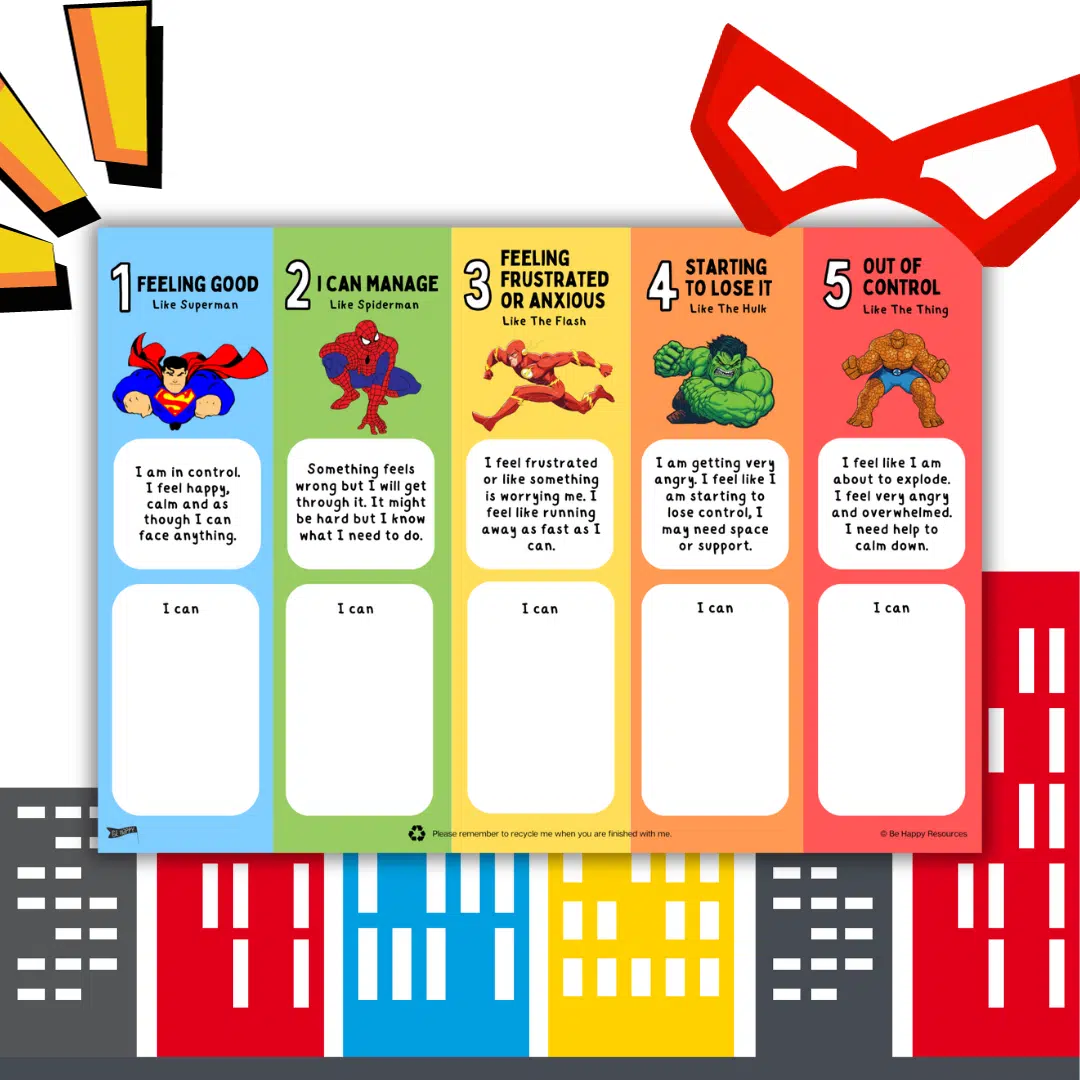
A feelings poster tells you which emotion. A five-point scale tells you how strong it is — and that is what determines which strategy will actually work. A 2 needs a deep breath; a 5 needs to leave the room. Our 5 Point Superhero Scale frames this as a superhero power level, which lands far better with children aged 5–10 than a clinical-looking chart.
4. A breathing visual
Star breathing, square breathing, or a simple “trace the shape with your finger” graphic. The finger-tracing element matters: it gives the hands something to do, which is half the regulation.
Free calm down corner checklist
Print this page, or copy the list below onto card and pin it inside the corner. Work through it once and your space is set up properly.
- Somewhere soft and low to sit
- A feelings or colour-zones poster at the child’s eye level
- Four to six calming strategies, shown as pictures
- An intensity scale (1–5)
- One sensory item, maximum two
- A timer the child controls
- Agreed rules, written down and short
- Nothing in the corner used as a punishment
Calm down corner rules that work
Keep the rules to three or four, written in the child’s own words where possible:
- Anyone can use the corner, any time.
- You leave when you are ready, not when someone tells you.
- What happens in the corner is not discussed until afterwards.
- No one is ever sent here as a consequence.
That last rule is the one adults break most often, and it is the one that kills the whole system. The moment the corner becomes a place a child is sent, it stops being a place a child goes.
Home vs classroom
At home, the corner can be softer and more private — a pop-up tent or a wardrobe with the door removed works well. In a classroom, visibility matters for supervision, so use a low bookshelf as a partial screen rather than a fully enclosed space, and agree a silent signal a child can use to indicate they are heading there.
In both settings, the corner works best when the emotional vocabulary has been taught outside of crisis moments. Games are the easiest way to do that — Emotion Chess and Pass It or Keep It both build the language during calm moments so it is available during hard ones.
Three common mistakes
- Too many options. Six strategies maximum. More choice means more overwhelm.
- Text-heavy posters. If a child has to read a paragraph while dysregulated, the poster has failed. Pictures first, words second.
- Only introducing it during a meltdown. Set the corner up together on a calm day. Let the child choose where it goes and what is in it.
Frequently asked questions
What age is a calm down corner for?
Roughly ages 3 to 12. Under 3, the child needs a co-regulating adult more than a space. Over 12, the same principle works but call it something else — most teenagers will not use anything labelled a “corner”.
How long should a child stay in it?
As long as they need. If you are enforcing a duration, it has become a time-out. A five-minute sand timer is useful as a guide the child controls, not as a rule you impose.
What if my child refuses to use it?
Usually one of two causes: it was introduced during a meltdown, or it has been used as a consequence at some point. Reset it — move it, rebuild it together, rename it, and model using it yourself when you are frustrated.
Make the calm corner easy to use
For a ready-to-print set of signs, check-ins and coping prompts, see the Calm Down Corner Kit. If you are starting with a free setup, you can also download the Calm Corner Starter Kit and build the space one small step at a time.
Add comment