
No products in the cart.
Zones of Regulation Printables: Free Activities, Charts and PDF Ideas
The Zones of Regulation framework sorts feelings into four colours — blue, green, yellow and red. It works because it gives children a shared, non-judgemental vocabulary for internal states that are otherwise very hard to describe. No zone is “bad”. The goal is not to stay green; the goal is to notice which zone you are in and know what helps.
Below is a practical guide to the printables that make the framework stick, what each one is for, and the mistakes that stop them working.
The four zones, briefly
- Blue zone — low energy: sad, tired, bored, unwell.
- Green zone — regulated: calm, focused, content, ready to learn.
- Yellow zone — heightened but still in control: worried, excited, frustrated, silly.
- Red zone — intense and out of control: furious, panicked, elated, terrified.
The yellow zone is the one that matters most in practice. Yellow is where intervention still works. Once a child is in red, you are no longer teaching — you are containing. Every good printable is really a tool for catching yellow.
Zones of Regulation printables worth making
A four-colour check-in chart
The workhorse. A simple chart with the four colours and a movable marker — a peg, a magnet, or a laminated arrow. Used two or three times a day at predictable moments (waking, after school, before bed), not only during difficulty. Checking in when calm is what builds the habit.
A zones poster with faces
Younger children match faces before they match words. A poster showing four to six facial expressions per colour gives a non-reader a way in. Keep the text minimal and the images large.
A toolbox card per zone
This is the part most people skip, and it is the part that actually changes behaviour. Each zone needs its own strategies, because the strategies are not interchangeable:
- Blue: movement, cold water, sunlight, talking to someone, a snack.
- Green: nothing needed — name it and enjoy it.
- Yellow: breathing, a short walk, a fidget, asking for a break, counting down.
- Red: leave the situation, heavy physical input, silence, no talking until the wave passes.
Colouring pages
Underrated. Getting a child to colour in the four zones themselves — and draw their own face for each — produces far more buy-in than handing them a finished poster. The act of making it is the lesson.
Activities that teach the zones
Charts on a wall teach recognition. Activities teach application. A few that work:
- Zone sorting. Read out a scenario — “your team lost”, “you got a surprise” — and have the child place it in a zone. Disagreements are the useful part: the same event puts different people in different zones.
- Character spotting. Pause a film and ask which zone a character is in and what tipped them there.
- Zone of the day. Everyone at the dinner table names their zone and one thing that moved them between zones.
- Board games. Play removes the pressure of talking about your own feelings directly, which is exactly why it works with children who deflect.
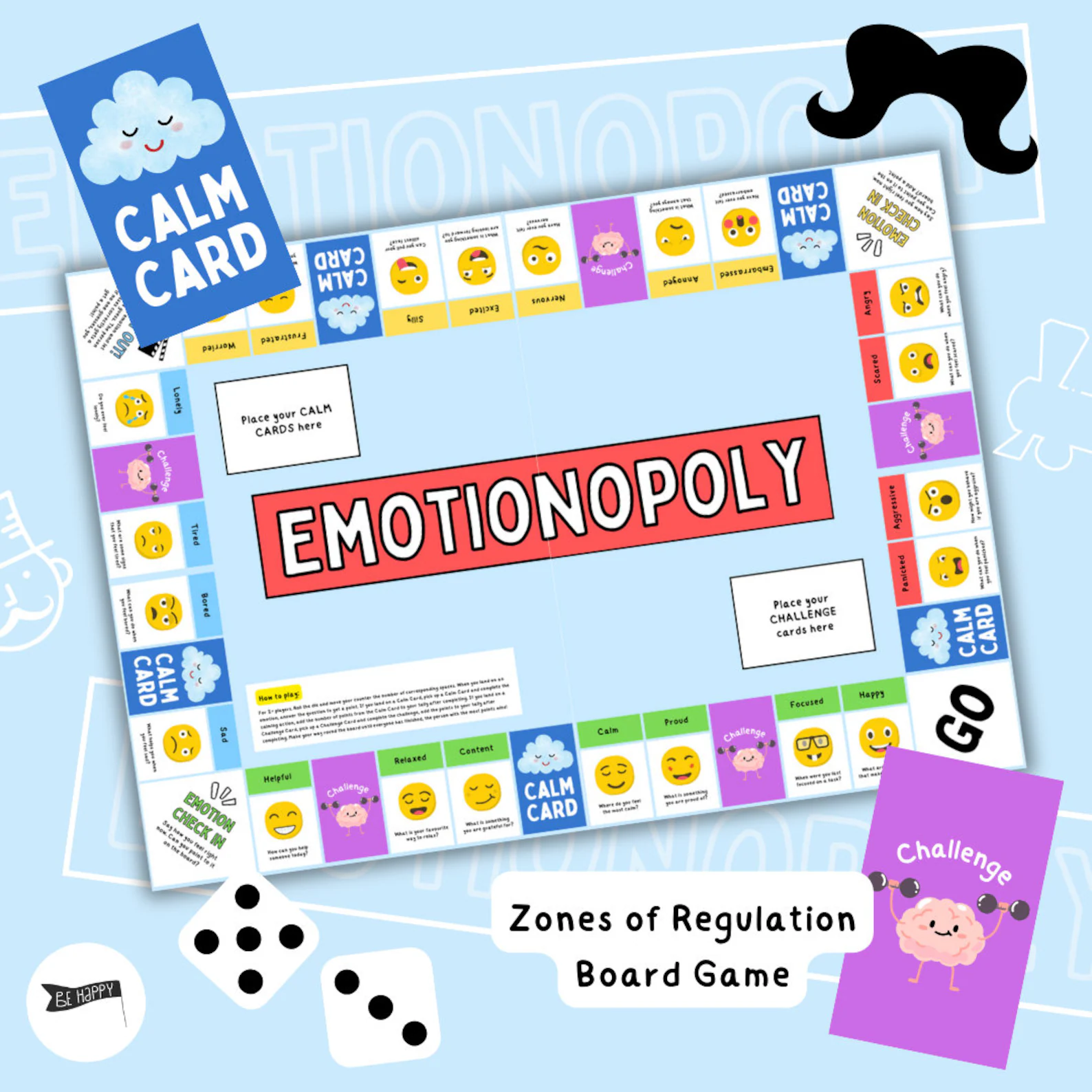
Our Emotionopoly printable Zones of Regulation board game is built around that last point — it is an instant-download PDF that turns zone identification and strategy choice into gameplay, so the practice happens before it is needed.
How intensity changes the strategy
Two children can both be “in the yellow” and need completely different things. Pairing the zones with a 1–5 intensity scale solves this: the colour tells you the type of state, the number tells you how much support is required. Our 5 Point Superhero Scale covers the intensity side in a format children actually engage with.
Where to put the printables
At the child’s eye level, in the room where dysregulation actually happens — which is usually the kitchen, the hallway by the front door, or wherever homework gets done. A beautiful poster in a bedroom nobody uses at 4pm does nothing. Pair it with a dedicated calm down corner so there is somewhere to go once a zone has been named.
Common mistakes
- Treating green as the goal. If green becomes the “good” zone, children start hiding the others. Name your own yellow and blue out loud regularly.
- Asking “what zone are you in?” mid-meltdown. In red, the question is an accusation. Ask afterwards.
- Printing everything at once. Start with one check-in chart. Add a toolbox when the chart is genuinely being used.
- Adult-made only. Let the child draw, colour and choose. Ownership drives use.
Frequently asked questions
What age are Zones of Regulation printables for?
Typically 4 to 12. Younger children need face-based visuals; from about 9 upwards you can move to words and intensity numbers. Teenagers respond better to the same concept stripped of the colour branding.
Do the zones work for autistic and ADHD children?
Often very well, because the framework externalises an internal state and removes the need for precise emotional vocabulary. Expect to spend longer on the interoception step — noticing the body signals that indicate a zone — and be flexible about which strategies land. For older teens, our ADHD & Me workbook covers similar ground in an age-appropriate way.
How long before it works?
Recognition usually takes two to four weeks of daily check-ins. Independent use of a strategy in the moment takes months. That gap is normal and is not a sign the system has failed.
More emotional-literacy printables
For flexible tools that help children name feelings and notice intensity, explore the Feelings Wheel Printable Pack and the Emoji Feelings Chart Pack. They can be used alongside any colour-based feelings routine at home or in class.
Add comment