
No products in the cart.
Feelings Chart for Kids: Printable Faces, Emoji Charts and How to Use Them
A feelings chart gives a child a way to communicate an internal state without needing the vocabulary to describe it. They point. That is the whole mechanism, and it is why a well-placed chart often does more than months of conversation.
But not all charts work. The ones that fail are usually too big, too wordy, or hung somewhere the child never looks. Here is what to use, at what age, and where to put it.
Types of feelings chart
Feeling faces chart
A grid of drawn faces, each labelled with one emotion. The most versatile format and the best starting point for ages 3–8. Six to twelve faces is the sweet spot — a chart with forty faces looks impressive on a wall and is unusable in practice.
Emoji feelings chart
The same idea using emoji instead of illustrated faces. The advantage is genuine: children already read emoji fluently from messaging apps, so there is no learning curve. Particularly effective with ages 7–12, who may find a drawn-faces chart babyish.
Colour or zone chart
Groups emotions into colour bands rather than naming each one. Lower resolution, but far lower effort for the child — useful when a child is already escalated and cannot manage a specific label. See our guide to Zones of Regulation printables for the full framework.
Intensity scale
Not “which feeling” but “how strong”, usually 1 to 5. Best used alongside a faces chart rather than instead of one. Our 5 Point Superhero Scale uses a superhero power-level metaphor, which gets far better engagement than a numbered thermometer.
Feelings wheel
A circle of emotion words in rings — broad in the middle, precise on the outside. It builds vocabulary rather than just recording a state, but it needs reading and comparison, so it suits ages seven and up. See our guide to the feelings wheel for kids for how to use one and how to make your own.
Which emotions to include
Start with the six that cover most of what a young child experiences: happy, sad, angry, scared, tired, calm. Once those are used reliably, add the more precise ones — frustrated, embarrassed, jealous, disappointed, nervous, proud, lonely, overwhelmed.
That second list is where the real value sits. A child who can distinguish “frustrated” from “angry” has a much better chance of responding proportionately, because the two call for different responses.
By age
- Ages 2–4: four to six large faces. No text needed. Point and name it for them out loud.
- Ages 5–7: eight to twelve faces with single-word labels. Introduce a daily check-in routine.
- Ages 8–11: emoji format, more nuanced emotions, plus an intensity scale.
- Ages 12+: drop the chart on the wall. Use a journal or a phone note instead — the privacy matters more than the visual at this age.
How to actually use it
The chart is not the intervention. The routine around it is.
- Check in at fixed times — after school and before bed are the two highest-yield moments. Do it whether or not anything is wrong.
- Model it yourself. Point at your own feeling first. “I am at frustrated today, because work was hard.” This does more than any prompting.
- Never argue with the answer. If a child says angry and you say “you are not really angry”, the chart is finished as a tool.
- Follow with one question, not five. “What would help right now?” is usually enough.
- Have an answer ready. “What would help” only works if the child has options. Build a shortlist from a list of coping skills for kids on a calm day.
- Accept pointing without talking. Silent use is still success.
Where to put it
At child eye level, in a high-traffic spot — the fridge, the back of the front door, the end of the bed. Not in a room that is only used at bedtime. If you have set up a calm down corner, put a second copy there, because that is where it will be needed most.
Beyond the chart
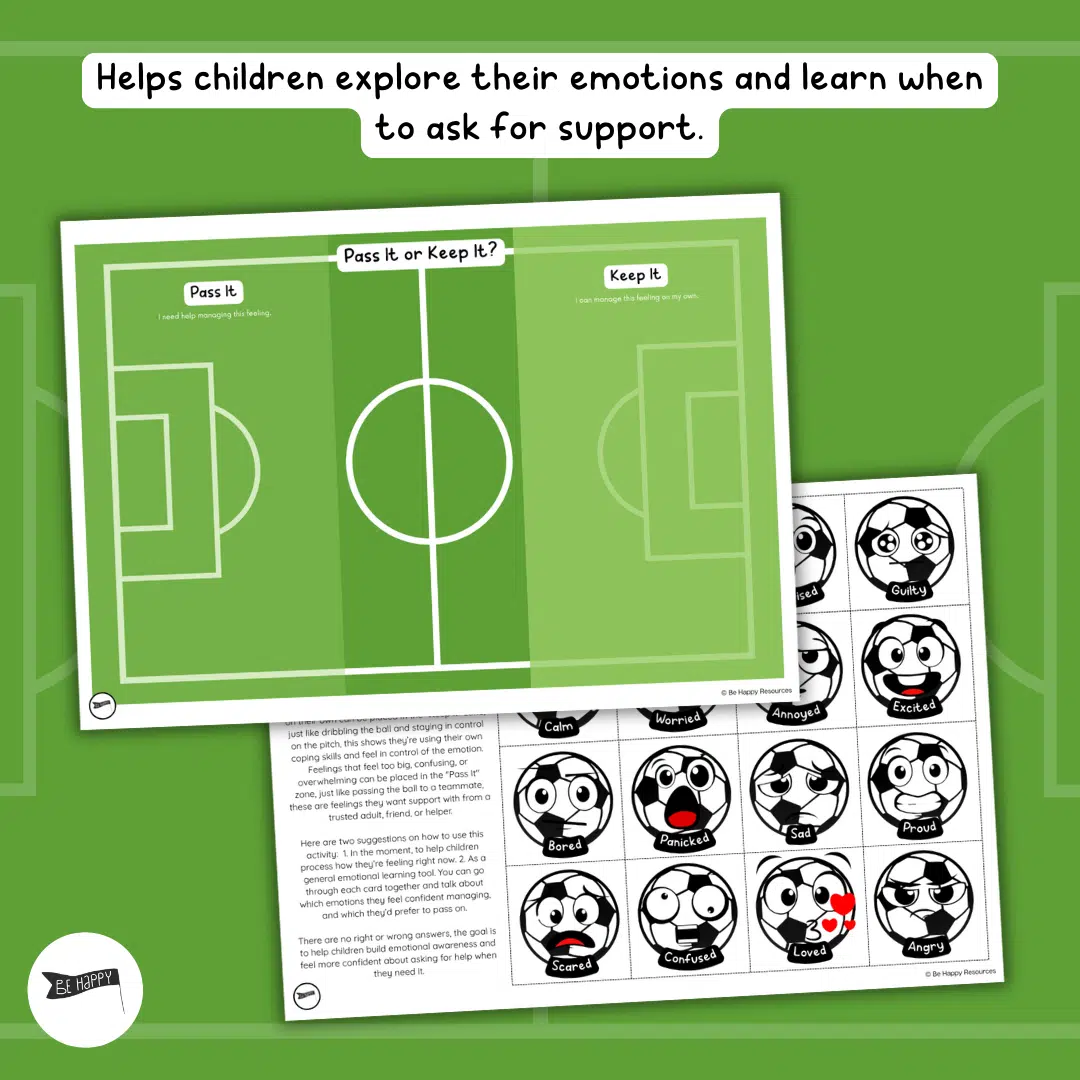
A chart builds recognition. Turning recognition into conversation usually needs something with lower social pressure — which is where games work. Pass It or Keep It gives children a structured, low-stakes way to share a feeling, and Emotion Chess builds discussion into an ordinary board game, which suits children who shut down when asked directly.
Frequently asked questions
My child always points at the same face. Is it working?
Often yes — young children default to the first or the happiest face for weeks before the responses differentiate. Keep going and keep modelling. If it persists past a month, the chart may have too many options; cut it down.
Should I laminate it?
Yes, if you want a dry-wipe marker or a movable peg. A chart the child can physically move a marker on gets used considerably more than one they only look at.
Do feelings charts work for autistic children?
Frequently, yes — a visual removes the demand for verbal processing at the hardest moment. Photographs of real faces, or of the child’s own face, sometimes work better than cartoon illustrations. Expect to spend longer connecting body sensations to the labels.
Printable tools to use with this guide
If you want a ready-to-print way to practise daily emotion check-ins, compare the Emoji Feelings Chart Pack and the Feelings Poster and Check-In Pack. Both are designed for simple, repeatable use at home or in a classroom.
Add comment