
No products in the cart.
Problem-Solving Scenarios for Kids: 6 Examples and Possible Solutions
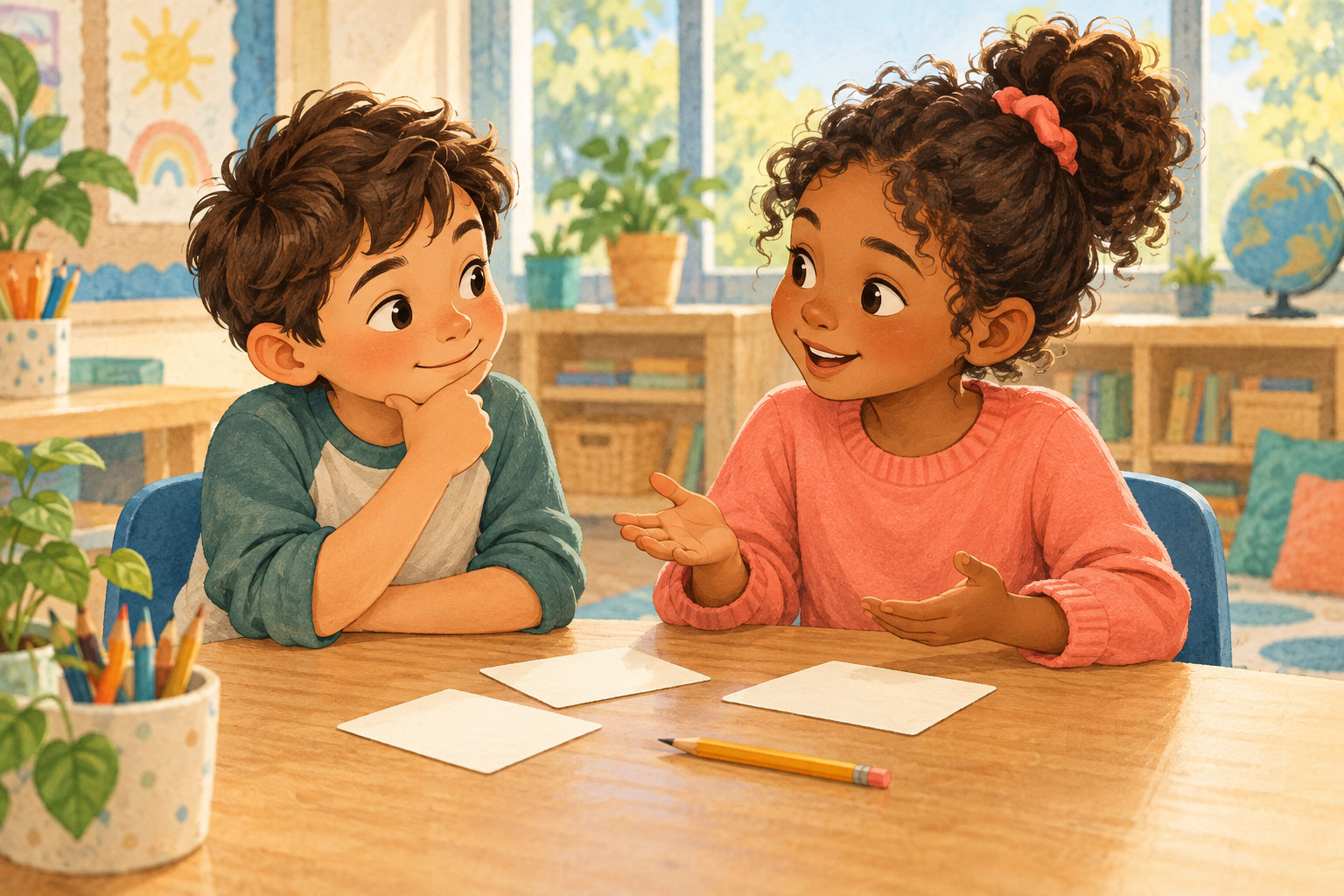
Two children want the same paintbrush. One says, “I had it first.” The other says, “You’ve had it forever.” This is the sort of small moment that can suddenly become a big one. An adult could decide whose turn it is—but if everyone is safe, there is also a chance to help the children work out a next step.
These six problem-solving scenarios for kids give you a place to start. Read one aloud when things are calm, let your child suggest an ending, and try another ending if the first one does not feel fair. They are written for roughly ages 6–10; adapt the words and expectations to the child in front of you. You do not need to finish all six or print anything.
How to use one scenario in five minutes
Ask, “What is the problem?” Then ask, “What else could they do?” before offering your own solution. Talk through what might happen next for both people. Choose a safe first step and check later whether it helped. If the child is upset, pause the conversation first; our coping skills for kids guide has simple ways to take that pause.
A sentence to keep handy: “That is one idea. What is another?” It makes room for the child’s thinking without pretending every choice will work.
1. Name it
“What happened?” Describe the problem without naming a “bad kid.”
2. Find options
“What are two possible next steps?” Think about how each person might feel.
3. Try and check
“Which step is safe to try first?” Later, ask if it helped or needs a different plan.
This is a discussion tool, not a test. Children can talk, point, draw two endings or act them out with toys instead of writing answers.
Six everyday problem-solving scenarios
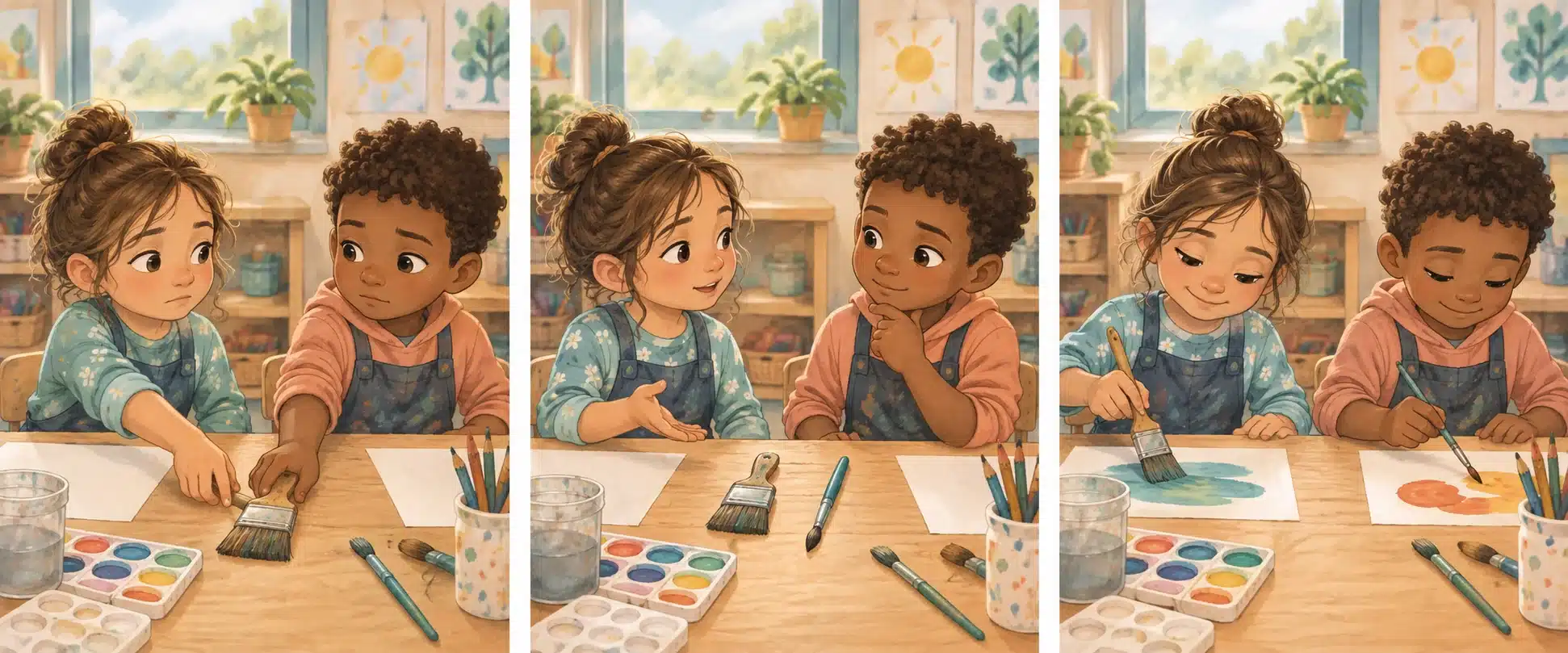
1. One paintbrush, two artists
Maya and Eli both reach for the only wide paintbrush. Maya says she was using it; Eli says he needs it to finish before art time ends.
Try asking: “What does each child need right now?” One possible plan is a short turn with a clear end. Another is to see whether a different brush works for part of Eli’s picture. Ask which plan they would both agree to. If one child grabs or the argument escalates, pause and help them reset rather than demanding an instant agreement.
Words a child could try: “I’m not done yet. Can we set a timer, or is there another brush?”
2. The rules change in the middle of a game
A playground game is halfway through when a player announces a new rule. Some children think the change is fun; others think it is unfair.
Try asking: “Was the rule agreed on before this round?” The group might finish the round with the old rules and try the new rule next time, or stop and agree on a change everyone understands. Neither works if someone is being pressured or excluded; an adult can help make the rules clear.
Words a child could try: “I’m confused. Are we changing the rules now or after this round?”
3. The school book is still at home
Noah gets to class and remembers the book for today’s activity is on the kitchen table. He is tempted to say nothing and hope nobody notices.
Try asking: “Who can help before the activity starts?” Noah could tell the teacher and ask about sharing a copy, or ask for another approved way to take part today. The useful step here is asking early—not inventing an excuse.
Words a child could try: “I forgot my book. What can I use for today’s activity?”
4. A child is left out of a game
Three children have started a game. A fourth asks to join, and one player says, “There’s no room.”
Try asking: “Does ‘next round’ sound like a real invitation if the rounds never end?” The children could make a new role, change teams or agree on a specific short turn. The child who was left out may also decide to play elsewhere. If exclusion keeps happening, it is not that child’s job to solve it alone; tell a trusted adult.
Words a child could try: “Can I join this round, or will you tell me when the next one starts?”
5. The group poster has two workers and two watchers
Four children are making a poster. Two are drawing while the others are standing nearby, unsure what to do.
Try asking: “Are the other two refusing, or do they need a job they can actually start?” The group might list what is left—drawing, lettering, checking instructions—and let everyone choose. Or they might ask the teacher to clarify the task. Avoid calling a classmate “lazy” before finding out what is stuck.
Words a child could try: “We still need a title and someone to check the instructions. Which part do you want?”
6. Water spills toward someone else’s work
Sam bumps a cup. Water moves across the table toward another child’s paper. Everyone looks at Sam.
Try asking: “What needs doing first?” Moving the paper and telling people about the spill matter more than deciding who is to blame. Sam can ask where the cloths are and help clean up. If water is near electricity or the floor is slippery, an adult takes over immediately.
Words a child could try: “I spilled it. Please move your paper. Where can I get a cloth?”
Six possible next steps at a glance
These are examples, not answer keys. Ask the child what might happen next, whether the plan is safe, and whether it works for everyone involved.
- Shared paintbrush: Agree on short turns with a clear end, or find another brush that can do part of the job.
- Changing game rules: Finish this round with the agreed rules, then discuss a change for the next round.
- Forgotten school book: Tell the teacher early and ask how to take part today.
- Left out of a game: Ask for a specific turn or a new role; if exclusion continues, involve a trusted adult.
- Uneven group work: Name the remaining jobs and let each person choose a useful part.
- Water spill: Move nearby work out of the way, alert an adult if needed, then help clean up safely.
What if the child says, “I don’t know”?
Give them a moment. If they are still stuck, offer two imperfect ideas and ask what they would change: “They could take turns, or they could find another tool. What is the problem with each plan?” A child may spot an option an adult missed. The aim is not to make them recite a perfect answer; it is to practise noticing choices and consequences. You can return later if emotions are running high. A feelings chart for kids may help start that conversation.
A one-scenario worksheet you can make in a minute
Copy these prompts onto scrap paper or a whiteboard. This is a make-it-yourself activity, not a downloadable PDF:
- What happened? ___
- What might each person be feeling or needing? ___
- Two choices I can think of are ___ and ___.
- What might happen after each choice? ___
- My safe first step is ___. I can ask ___ for help.
For children who do not want to write, draw two endings or act them out. Use a real-life situation only if the child wants to discuss it; fictional scenarios can feel safer. One short conversation is enough for today.
When an adult should step in
Do not turn bullying, threats, hitting, repeated exclusion or a safety hazard into a “solve it yourself” exercise. Support the child directly and involve the responsible school or caregiver adult as needed. These examples are general educational activities, not clinical advice or a substitute for individual support.
For further reading on age-appropriate practice and adult coaching, see the American Academy of Pediatrics’ guidance on growing independence and Harvard’s executive-function activity guide.
Add comment