
No products in the cart.
Feelings Games for Kids: Bingo, Matching, Jenga and Card Game Ideas
Children who deflect direct questions about their feelings will often talk freely across a board game. The game gives them something to look at other than your face, a reason to be there that is not “we need to talk”, and permission to stop whenever they like. That is not a trick — it is a genuinely lower-pressure format for a hard subject.
Here are feelings games that work, most of them buildable from things you already own.
Feelings bingo
Grids of emotion faces instead of numbers. Call out a scenario rather than the emotion itself — “your best friend moved away” — and let each player mark whichever feeling they think fits.
The disagreements are the point. When one child marks “sad” and another marks “angry” for the same scenario, you have a natural opening to discuss how the same event produces different feelings in different people. Best for ages 5–9, in groups of three or more.
Feelings matching game
A memory-pairs game with emotion faces. Three ways to play, in increasing difficulty:
- Face to face — match two identical expressions. Ages 3–5.
- Face to word — match the expression to its label. Ages 5–8.
- Face to scenario — match the expression to a situation card. Ages 7+, and much more useful.
Add one rule to any version: when you win a pair, name a time you felt that way. Optional, never enforced — but most children volunteer something within a few rounds.
Feelings Jenga
Write a colour or a number on each block of an ordinary Jenga set, then keep a key: red blocks mean name something that made you angry this week, blue means something that made you sad, and so on.
The tower physically holds the attention, which is exactly why it works with children who cannot sit through a conversation. The tension of the tower does the emotional regulation work for you. Excellent for ages 8–14 and for one-to-one sessions.
Feelings Uno
Assign a prompt to each colour in an ordinary Uno deck — red for angry, blue for sad, green for calm, yellow for worried. Every time you play a card, say one word about a time you felt it. Skip and Reverse cards can pass the question on, which gives a reluctant child a legitimate exit.
That exit route matters more than it sounds. A child who knows they can pass will engage more, not less.
Emotion charades
Act out an emotion without words; everyone guesses. Trivially simple, and it teaches the thing children most need in order to read a room — that emotions have physical signatures in posture and face, not just in words.
Progress from the obvious six to the harder ones: embarrassed, jealous, disappointed, relieved, proud, overwhelmed.
Ready-made printable games
If you would rather not build from scratch, these are instant-download PDFs you print at home:
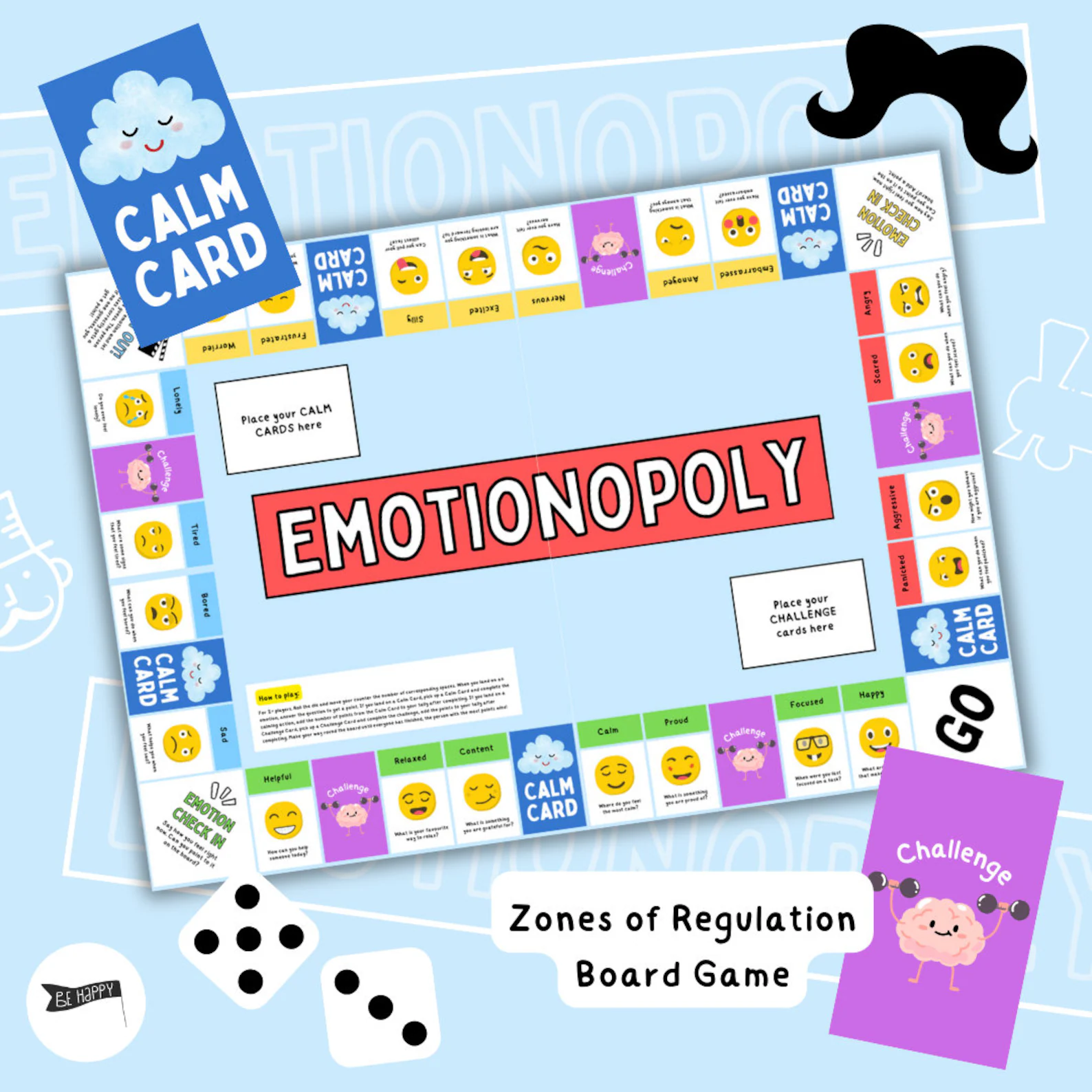
- Emotionopoly — a full board game built on the four-colour zones framework, covering both identifying a state and choosing a strategy. Ages 6–12.
- Emotion Chess — ordinary chess with discussion cards attached to captures. Suits older children and teenagers who find explicit feelings games patronising.
- Pass It or Keep It — a football-themed sharing activity where the child decides whether to answer or pass, which makes it unusually good for guarded children.
- Roll & Laugh — a lighter dice game for family game night, useful for warming a group up before anything heavier.
Getting more out of any feelings game
- Play when nothing is wrong. A feelings game produced immediately after a meltdown reads as a punishment.
- Answer first yourself, and answer honestly. A real adult answer sets the depth for the whole game.
- Let passing be free. No penalty, no comment.
- Do not debrief. Resist summarising what was learned at the end. Let it sit.
- Stop early. Fifteen good minutes beats forty-five that end in resistance.
Games build vocabulary during calm. To use that vocabulary when it matters, pair them with a visible feelings chart and somewhere to go — see our guide to setting up a calm down corner.
After the game, if a child wants to explore what someone could do next in a tricky situation, try our free problem-solving scenarios for kids. It offers six short situations and questions to discuss; it is separate from the feelings games above.


Add comment